
Ogo Journal · 2026-10-04
Your Business Will Eventually Outgrow Your Inbox
When you’re small, you are the system. Then you grow.
By Bode Bamkole
When your business is small, you can get away with being incredibly disorganised.
I know because I’ve done it.
You’ve got a couple of customers. A few suppliers. Maybe a business partner.
Someone asks what you agreed six months ago and you think:
Give me a second.
Search your emails.
Search WhatsApp.
Type the company’s name into Google Drive.
Eventually, you find a PDF.
Problem solved.
It’s not a particularly good system.
But when you’re small, you are the system.
Then you start growing
This is something I’ve started appreciating much more as I’ve built businesses.
Complexity creeps up on you.
One customer becomes five.
One supplier becomes ten.
You start working with partners.
You hire people.
Maybe you open another location.
And if you’re running a gym, studio, clinic or wellness space, think about how quickly that can happen.
Equipment.
Maintenance.
Cleaning.
Software.
Coaches.
Recovery providers.
Landlords.
Insurance.
Corporate customers.
Every relationship potentially comes with another agreement, another renewal date and another set of terms somebody needs to remember.
When there are three of them, you probably can.
When there are 30, things get more interesting.
And eventually somebody asks a question that you don’t immediately know the answer to.
When does this contract expire?
How much notice do we have to give?
Does this renew automatically?
What did we actually agree they would provide?
Which contracts are coming up for renewal?
And suddenly you’re searching through emails again.
“I’ll find it” doesn’t scale
There’s a progression I’ve noticed as businesses grow.
At first:
I know the answer.
Then:
I know where to find the answer.
Eventually:
Someone else needs to be able to find the answer without me.
That last one changes things.
Because if every important piece of information ultimately requires the founder to remember where something is, you’ve created a bottleneck.
And this is the kind of problem that’s easy to ignore.
If you’re a gym owner, you probably didn’t open a gym because you were passionate about contract administration.
If you’re building a recovery space, you probably care more about the experience than where the maintenance agreement is stored.
If you’re good at sales, you’re probably thinking about the next customer rather than the notice period buried on page 17 of an agreement you signed nine months ago.
But boring infrastructure becomes increasingly important as you grow.
Especially when missing something boring can become expensive.
This is why MangoDocs got my attention
I’ll be transparent: Ogo works with MangoDocs.
But part of the reason I wanted to work with them was because I saw the product and immediately understood the problem.
We’ve had digital contracts for years.
You can electronically sign documents.
You can scan them.
You can store PDFs in folders.
Useful.
But that still leaves someone needing to actually understand what’s inside them.
What I liked about MangoDocs was being able to interact with your agreements much more like you’d interact with ChatGPT or Claude.
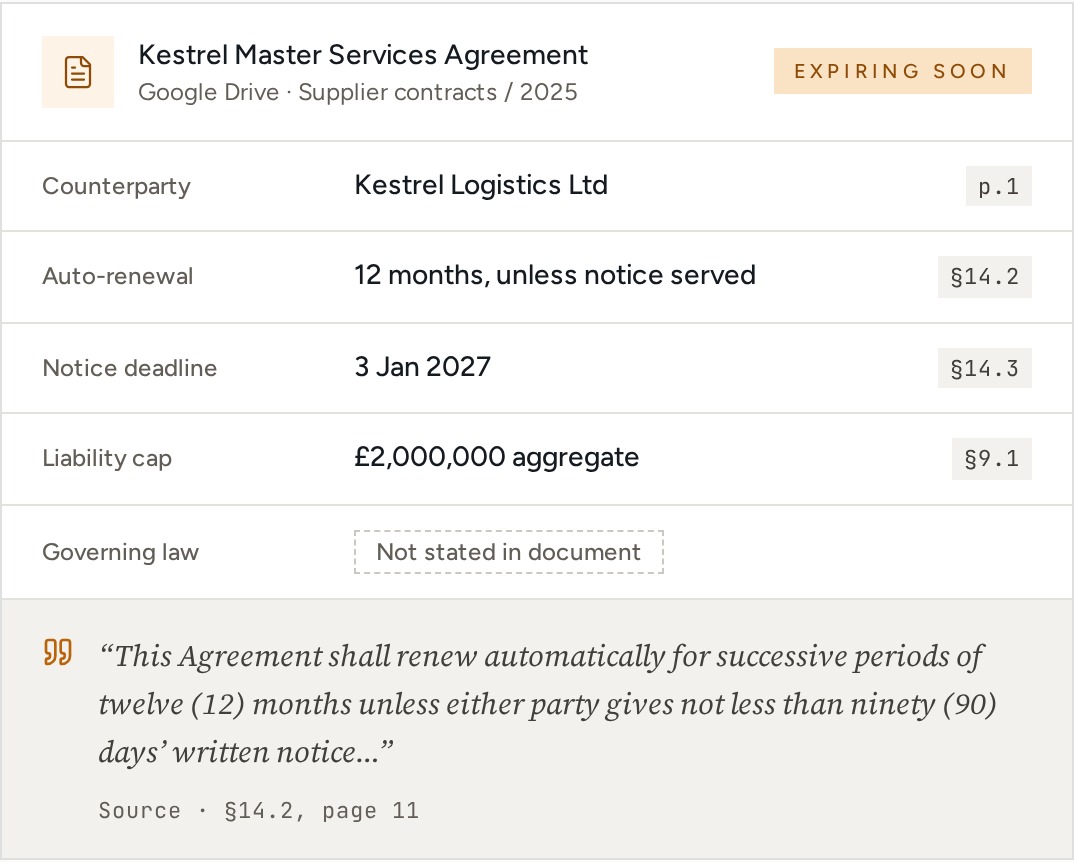
Instead of finding a contract and reading through it looking for a date, you can ask:
“When does this contract expire?”
Or:
“Which contracts are due for renewal?”
Or:
“What notice do we need to give?”
It can extract things like dates, renewal terms and obligations and take you back to the relevant source in the original agreement.
That’s a very different experience from simply having a folder full of PDFs.
The value isn’t really AI
AI is obviously the technology making this possible.
But I don’t think that’s the interesting part.
The interesting part is removing little pieces of friction.
Ten minutes searching for an agreement.
Another ten figuring out which version is current.
Someone messaging the founder because nobody else knows.
A renewal date nobody noticed.
An agreement you would have renegotiated if you’d remembered it was coming up.
One of those things isn’t going to destroy your business.
But as an organisation grows, you accumulate hundreds of these little pieces of operational friction.
And eventually they become someone’s job.
Good technology should make that job easier.
Build the infrastructure before you desperately need it
You don’t need enterprise infrastructure when you’ve got two contracts.
That’s probably why founders can ignore this stuff for so long.
I certainly did.
But there’s a point where the informal way you built the business starts becoming the thing that makes the next stage harder.
The information that used to live in your head needs to become accessible to other people.
The agreements buried in inboxes need to become usable information.
And the company needs to become slightly less dependent on somebody saying:
“I’m pretty sure I remember what we agreed.”
That’s part of growing up as a business.
And increasingly, I think the best operational technology is technology you barely notice.
You ask a question.
You get the answer.
You check the source.
And you get back to running the business.
Because your business should eventually outgrow your inbox.